Curious competitions: England’s eccentric heritage games
Long before VAR, mega sponsorship deals and esports, England’s towns and villages spent centuries playing their own local games.
Part pageant, part battle, part ritual, part drinking contest — and always an excuse for people to get together and have a laugh.
These traditions are stitched from scraps of folklore, full of disputed origin stories and old family feuds. To this day they still bring out huge displays of local pride and community spirit.
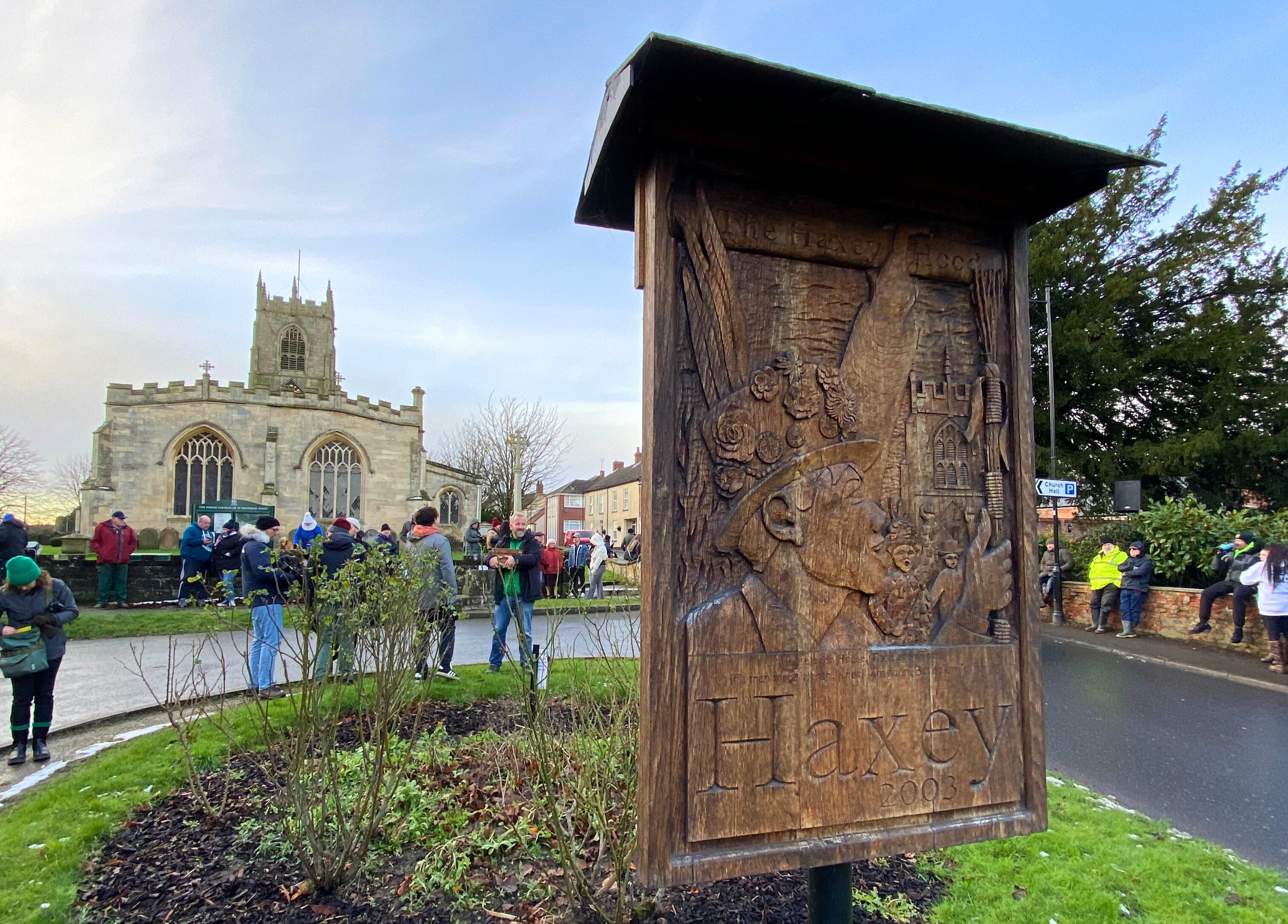
The Haxey Hood
House against house,
Town against town,
If a man meets another man,
Knock him down,
(But don’t hurt him!)
So begins the Haxey Hood.
Every Old Christmas Day since 1359, people from Haxey and nearby villages have gathered to join the Sway, one of England’s oldest — and muddiest — scrums.
Their aim is simple: to push a leather tube, called the Hood, into one of four local pubs — The Loco, The Carpenters Arms, The Kings Arms or The Duke William.
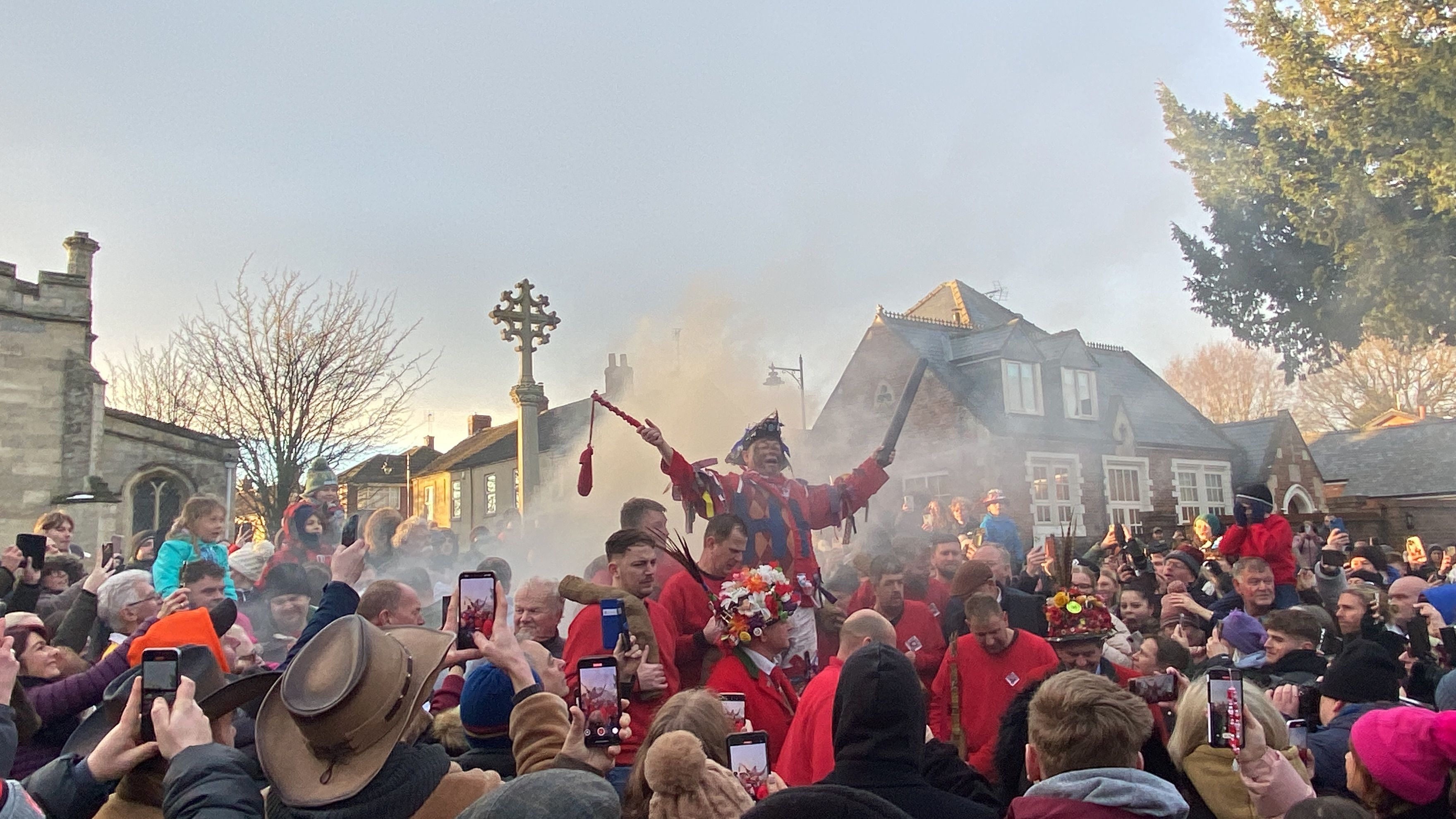
The game starts with a ritual called Smoking the Fool. Afterwards the crowd assembles in the Hood Field, a hill between Haxey and Westwoodside.
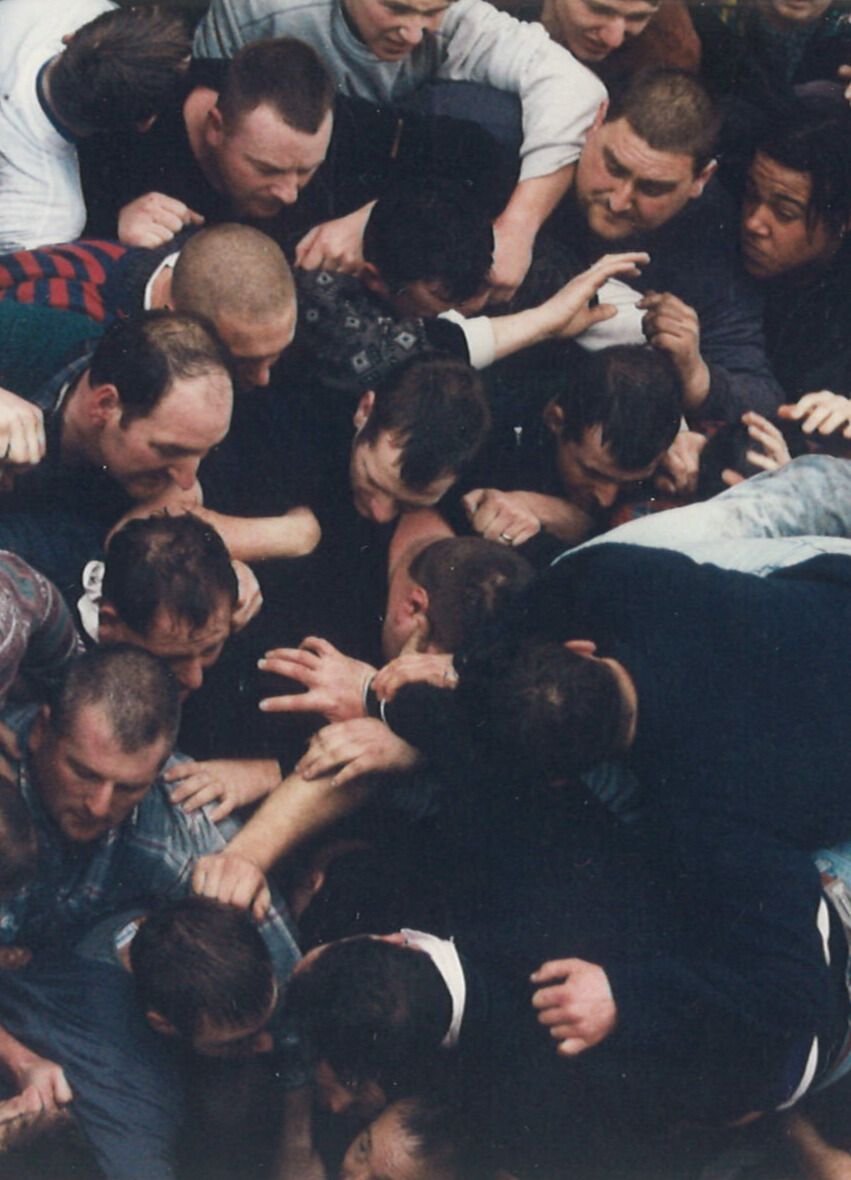
A tight pack forms. In the centre, a guest or local figure recites the ‘House against house’ poem. They then throw the Hood into the air and the Sway begins.
After two or more hours of play, slowly trampling anything in its path, the Sway eventually reaches one of the pubs.
The winning pub gets to hang the Hood above the bar until the next year’s game. They usually give everyone a free round of drinks too!
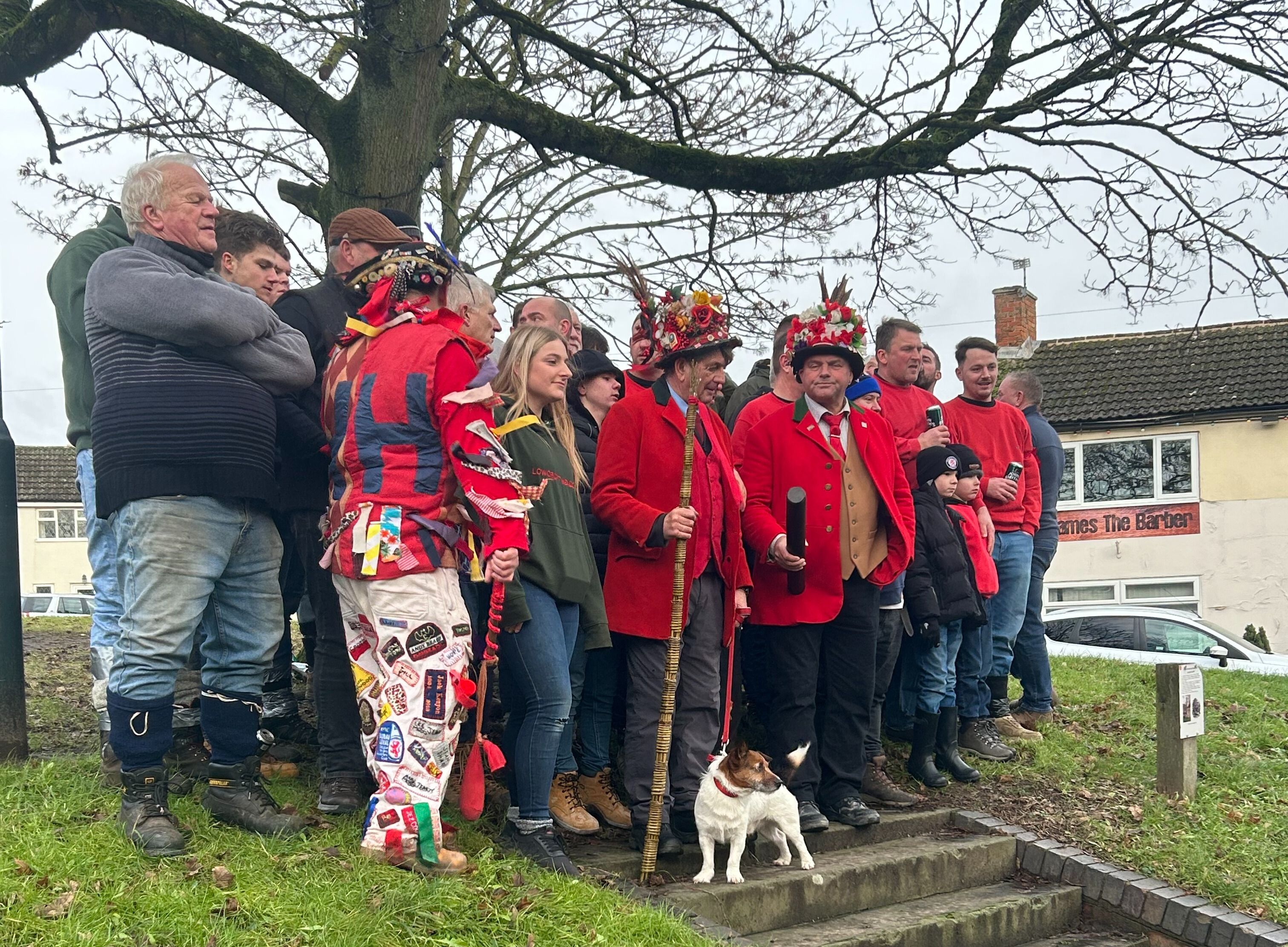
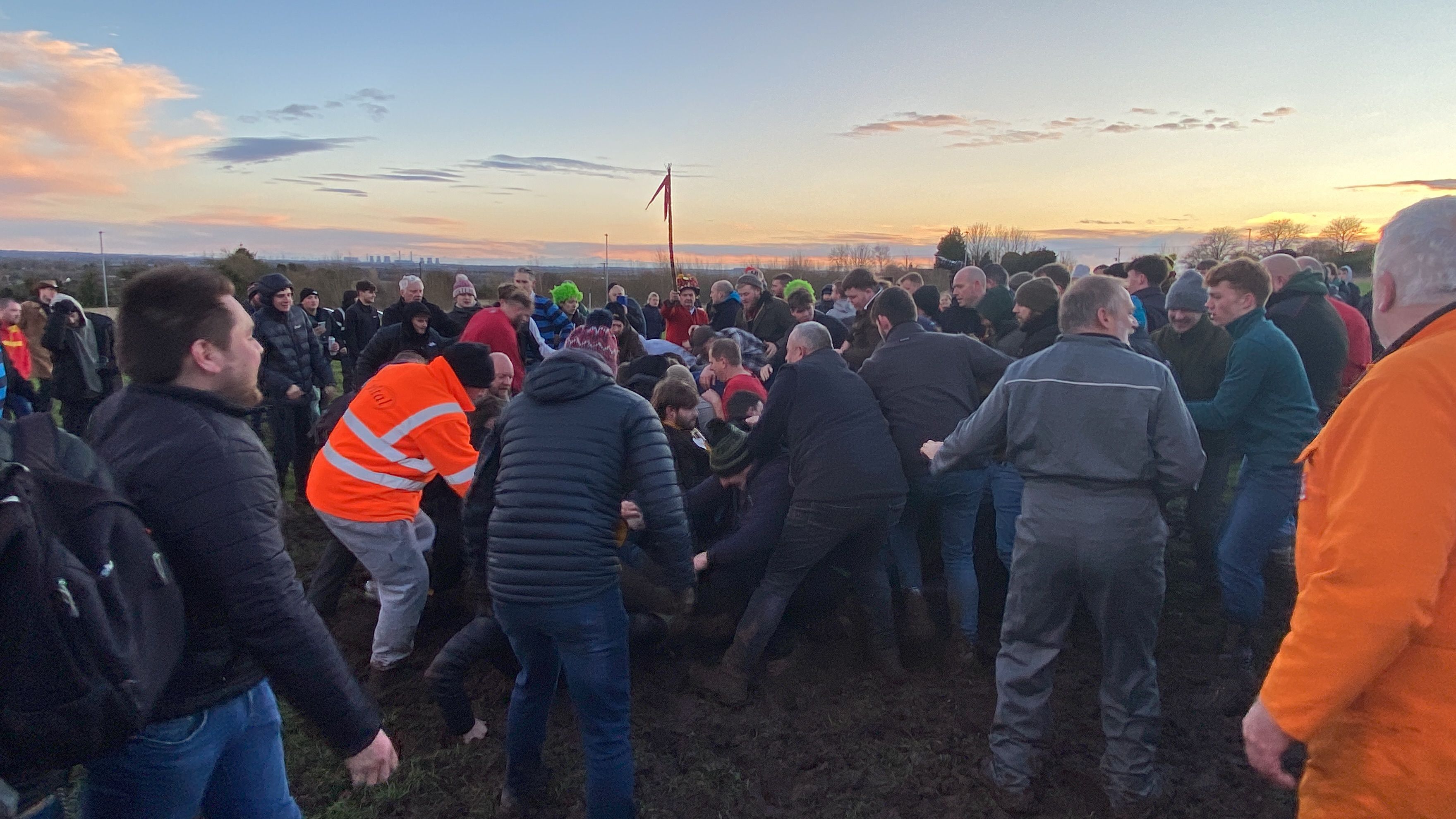
Members of the LibraryOn team, hosted by North Lincolnshire Libraries, were lucky enough to attend the Haxey Hood in 2025.
It was the 666th instalment of the competition and was won by The Loco.
Explore the notes beneath the photos above to discover the Hood’s key figures, objects and rituals.
Contested beginnings
Local legend says the Hood game began in the 14th century.
Lady de Mowbray, wife of the local landowner, was riding on the Isle of Axholme when a strong Lincolnshire breeze blew the red hood from her head.
13 farmhands chased the hood, eventually catching it in a field between Haxey and Westwoodside.
The boy who caught the hood was too shy to hand it back. A bolder friend did the honours. Lady de Mowbray praised him as a ‘Lord’, and called the shy boy a ‘Fool’.
She rewarded the men with 13 half-acres of land and was so tickled by the event that she ordered a re-enactment every year.
💡 It’s a neat story, but could there be another explanation?
The Lord’s willow wand, the red costumes and feathered hats, the 13 ‘Boggins’, the mock burning and the Hood itself — which doesn’t look like a hood at all — are not explained by the medieval tale.
“Students of folklore will probably recognise a much more ancient origin, and possible survivals of fertility rites” (Lincolnshire Folklore, Ethel R. Rudkin)
Smoking the Fool
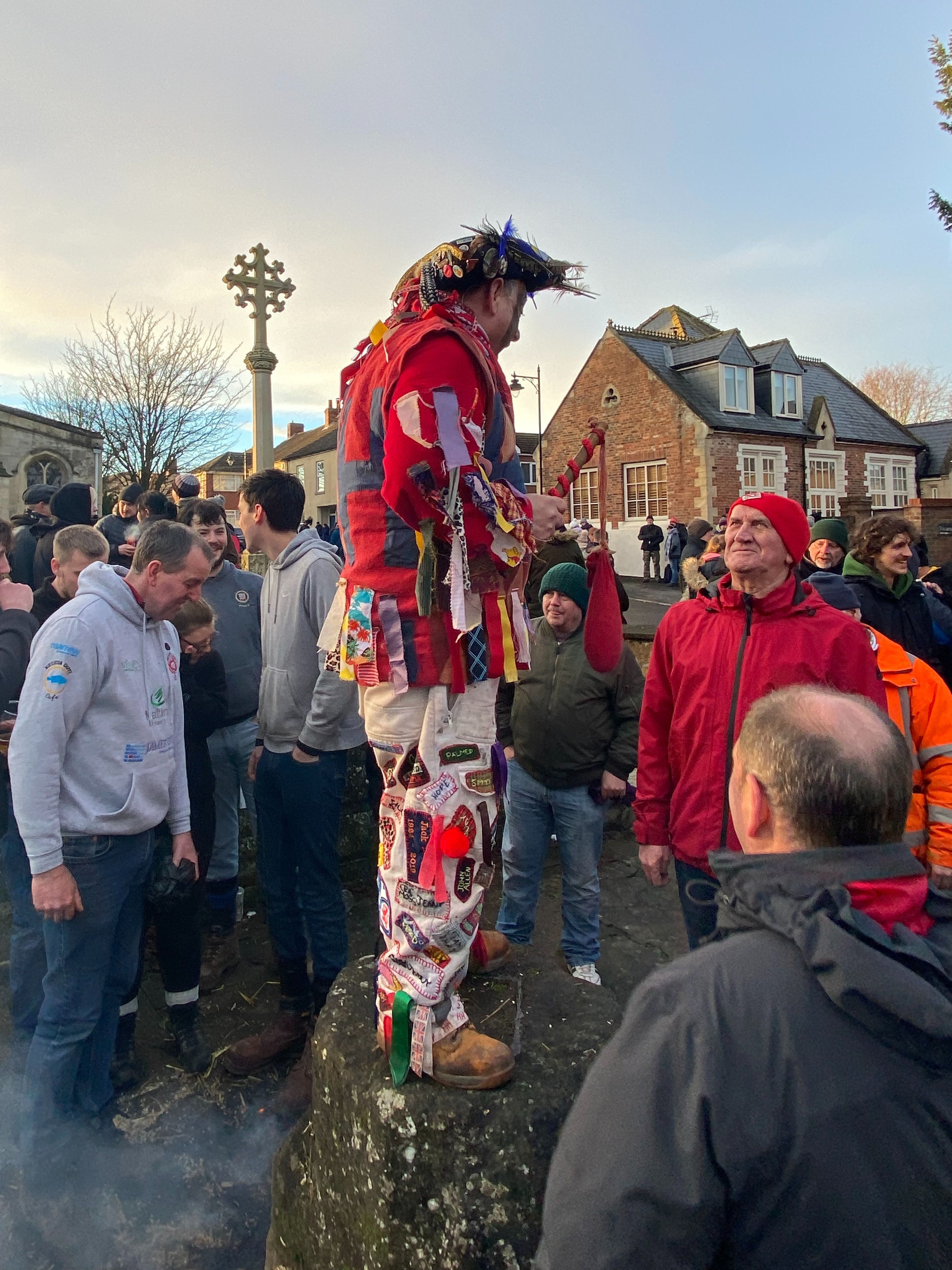
The game is overseen by 12 attendants in red outfits known as Boggins. They are led by the Lord of the Hood and the ceremonial 13th Boggin — the Fool.
After touring the local pubs, singing folk songs and spreading cheer, the Boggins gather everyone outside St Nicholas’ Church for the ritual of Smoking the Fool.
During the ritual, the Fool stands on a small platform called the Mowbray Stone.
Damp straw is lit behind him. In the past, the Fool was suspended over a bonfire, cut down and forced to scurry from the flames. Health and safety has (thankfully) intervened.
The Fool then gives a speech, joking about the year’s events, running through the rules and finishing with the ‘House against house’ poem.
The poem’s origins are ancient and unknown. Some believe the final line was added later to discourage violent play.
Learning more in the library
Tim Davies from North Lincolnshire Libraries explains how the local studies section at Scunthorpe Central Library helps people learn more about the Hood and its history.
Specialist books
Libraries are a great place to find reference books specialising in local history. Often these books are otherwise very hard to get hold of. Some may be independently published in small print runs, others may be antique and rare. Scunthorpe Central Library hold three beautiful Victorian books about the Isle of Axholme’s history. These are some of the definitive historical authorities on the Haxey area and its traditions, including the Hood game.
Local newspapers
The Epworth Bells was the local newspaper for the Haxey area from 1872 to 2019, when it was replaced by the Epworth Times. Almost every edition of the paper is held in the local studies section of Scunthorpe Central Library and is available to read upon request. Local newspapers are a great source for historical material, providing more detail and local colour than their national counterparts.
Microfilm
Microfilm is an early form of digitisation, developed in the post-war period. Primary sources (such as newspapers) are photographed onto a strip of film. The film is stored on a reel. Being sturdier than paper, materials are easier to store safely. Most modern microfilm readers transmit to a computer screen. The software includes features like zoom, image enhancement and screen capture.
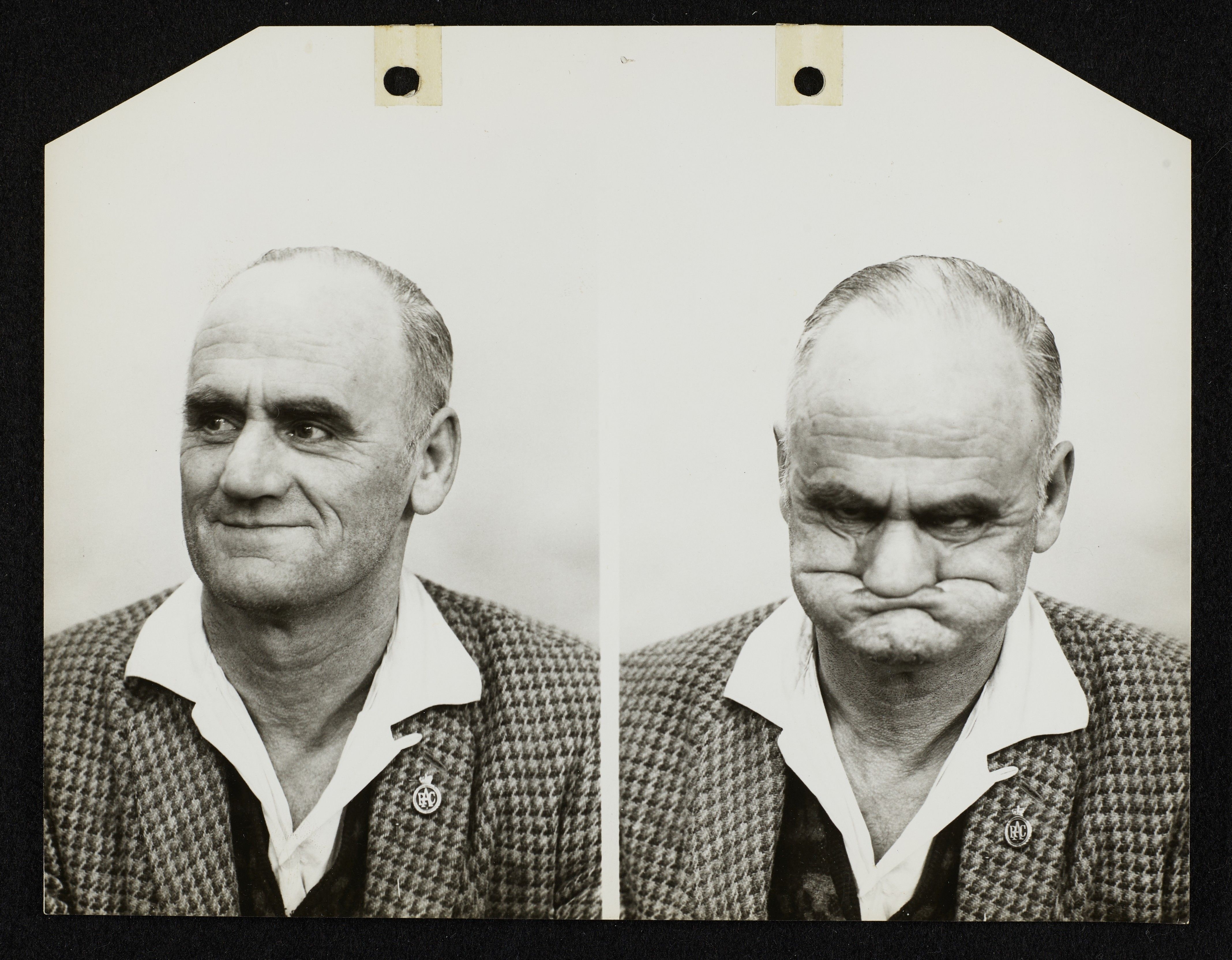
Egremont Crab Fair
The Egremont Crab Fair in Cumbria was first chartered in 1267 by Henry III as a market and harvest celebration.
It gave the Lord of the Manor a chance to thank local serfs for farming his land.
The ‘Crab’ in the name is thought to refer to crab apples, once thrown into the crowd from a horse-drawn cart.
This ritual takes place at midday and was originally called the Scattering of the Apples.
Now known as the Parade of the Apple Cart, the sour crab apples have been swapped for sweeter varieties.
But this story might be anachronistic. A 1775 account of the fair makes no mention of apple scattering, which suggests it may have more modern origins.
Past attractions included the cruel sports of bull baiting, cock fighting and “catching a pig with a soapy tail” (Memories of Egremont Crab Fair, R. Norman Roberts). These were banned in 1835.
Today’s fair includes competitive pipe-smoking, Cumberland wrestling, greasy pole climbing, street racing, horse-jumping and the famous World Gurning Championship.
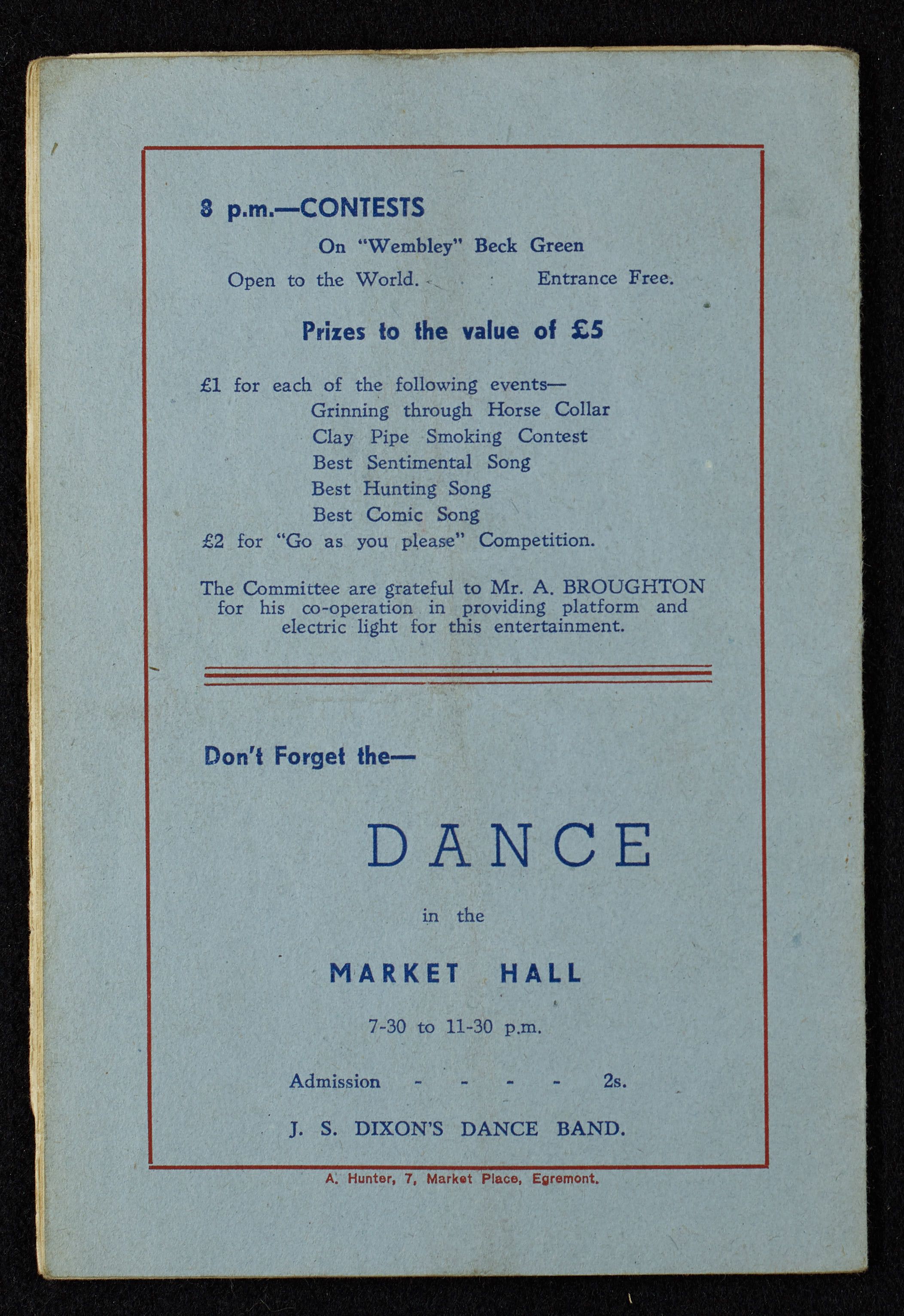
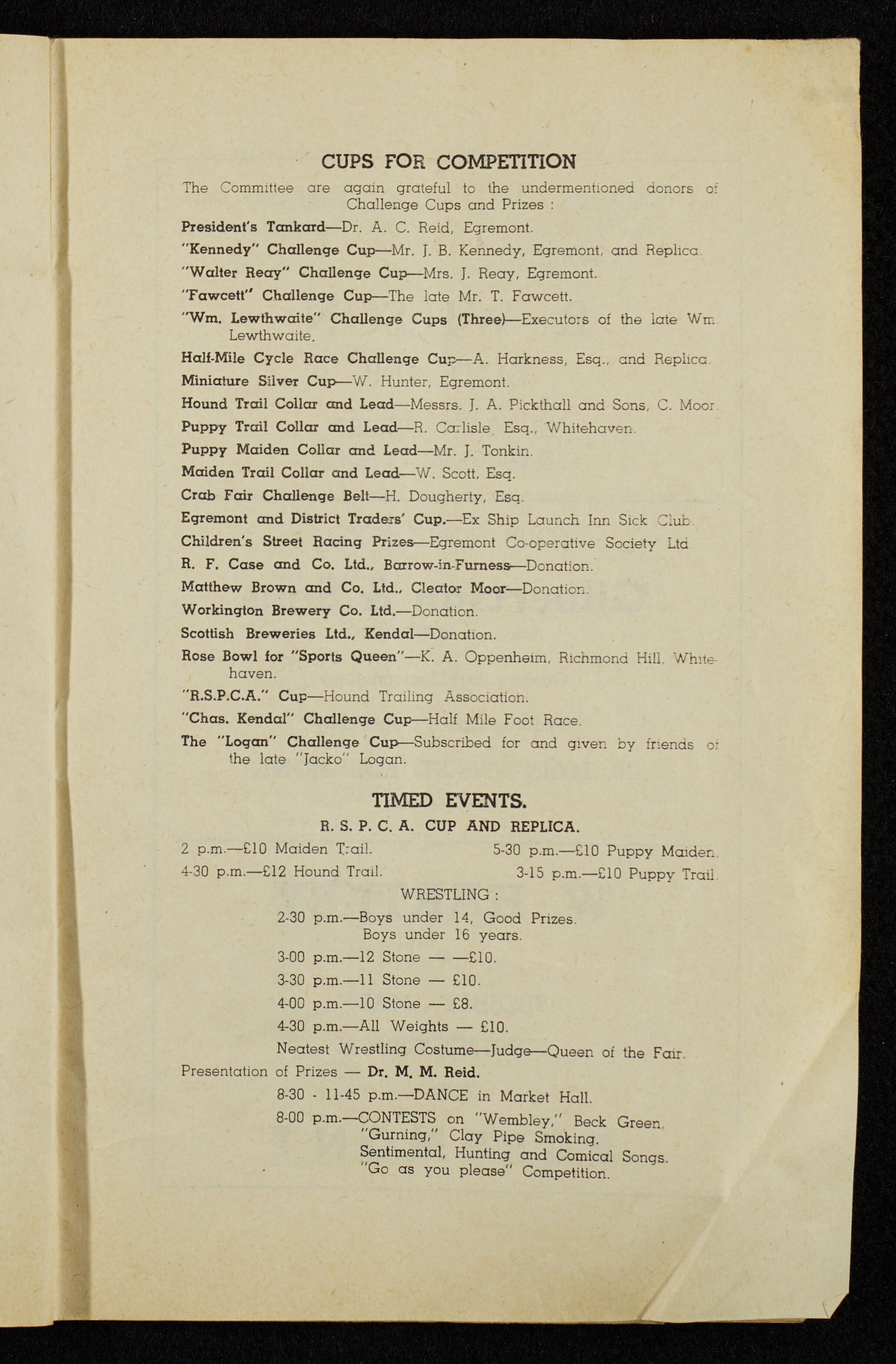
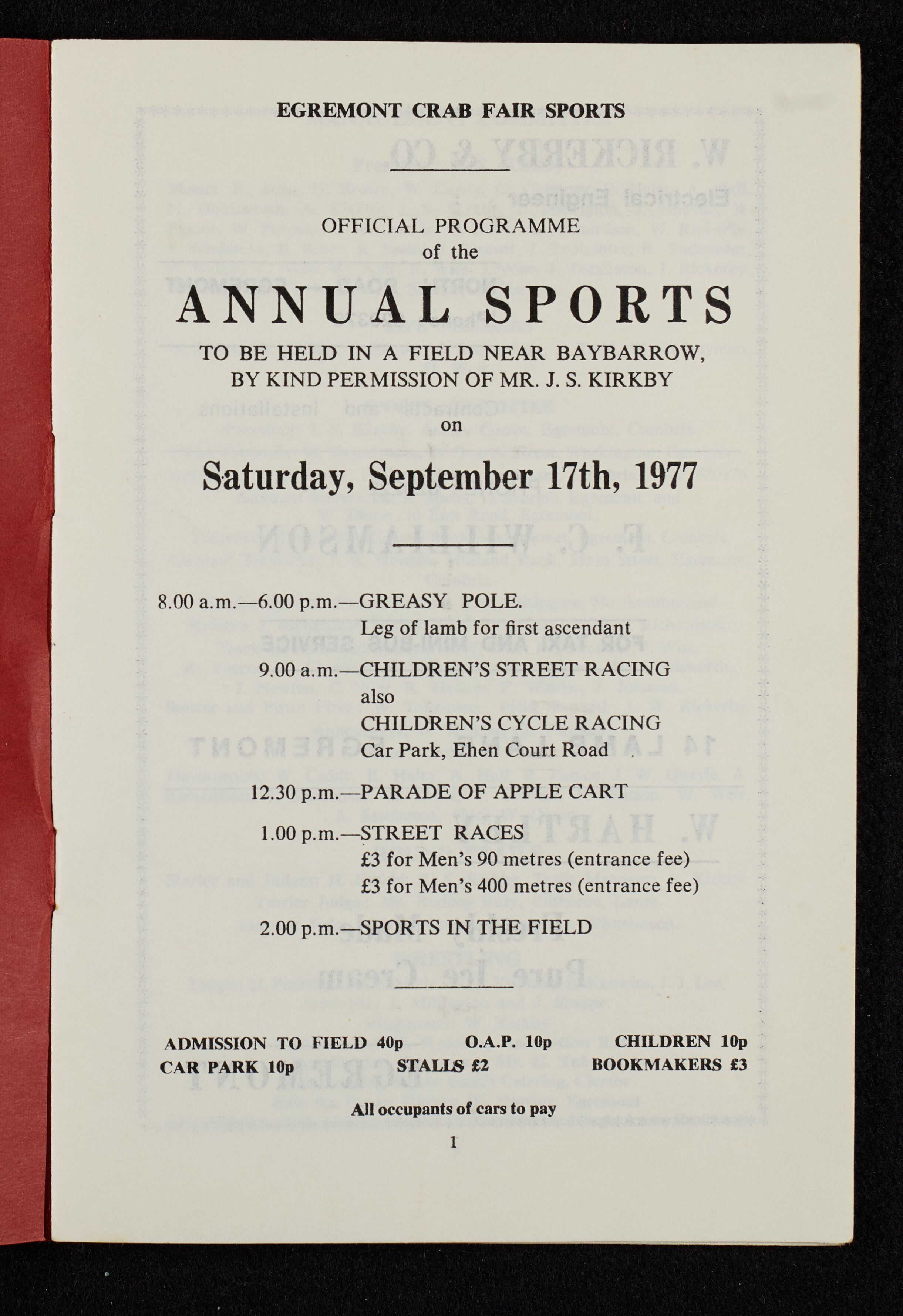
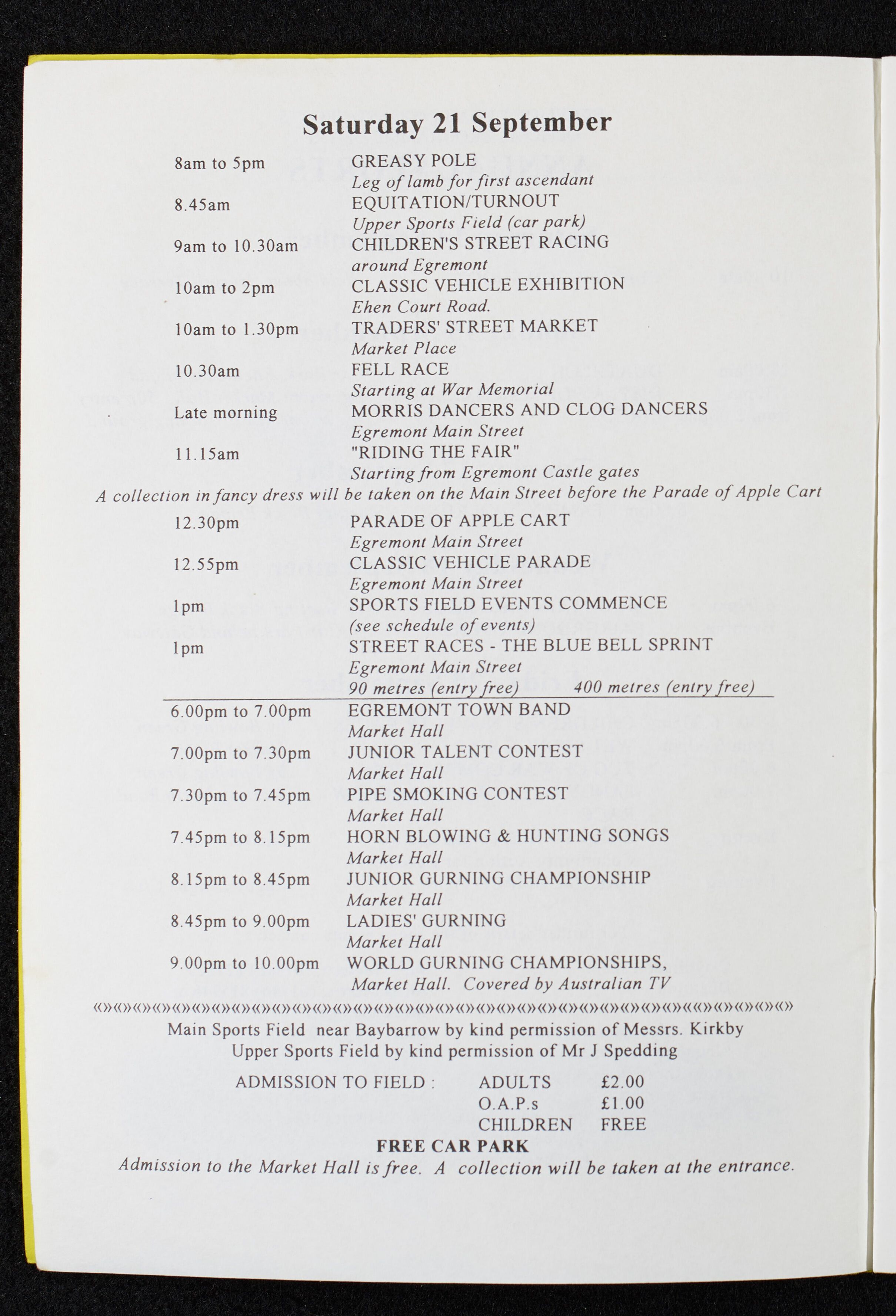
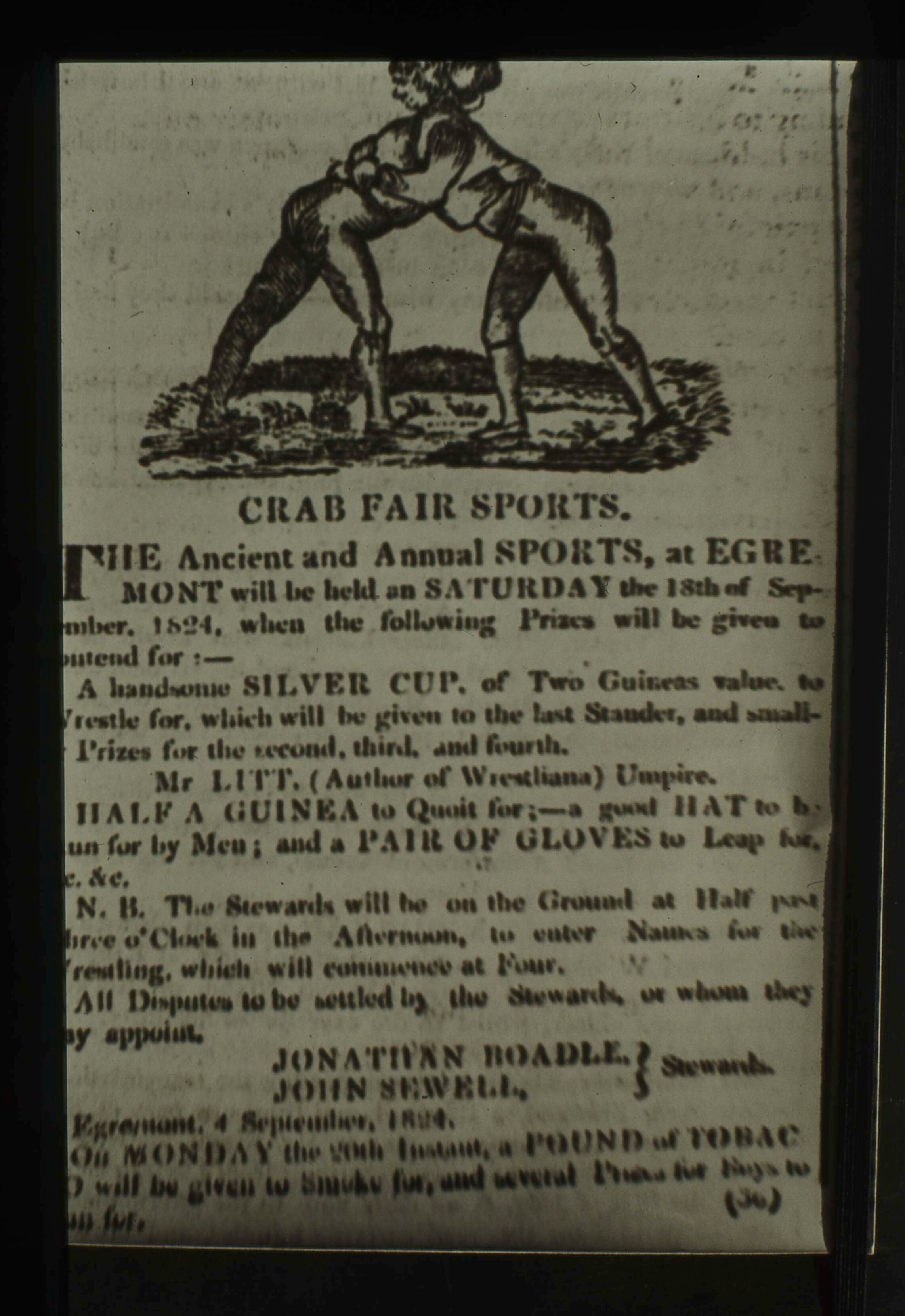
Programmes through the ages
Whitehaven Archive & Local Studies Centre is the home of Cumbria’s local history archive.
As well as photographs and specialist local history books, the archive holds several historical Crab Fair programmes.
Extracts from the programmes of 1952, 1963, 1977 and 1996, as well as a slide advertisement from 1824, are digitised here for the first time.
Explore the notes beneath each programme above to trace the Crab Fair’s evolution.
Gurning for glory
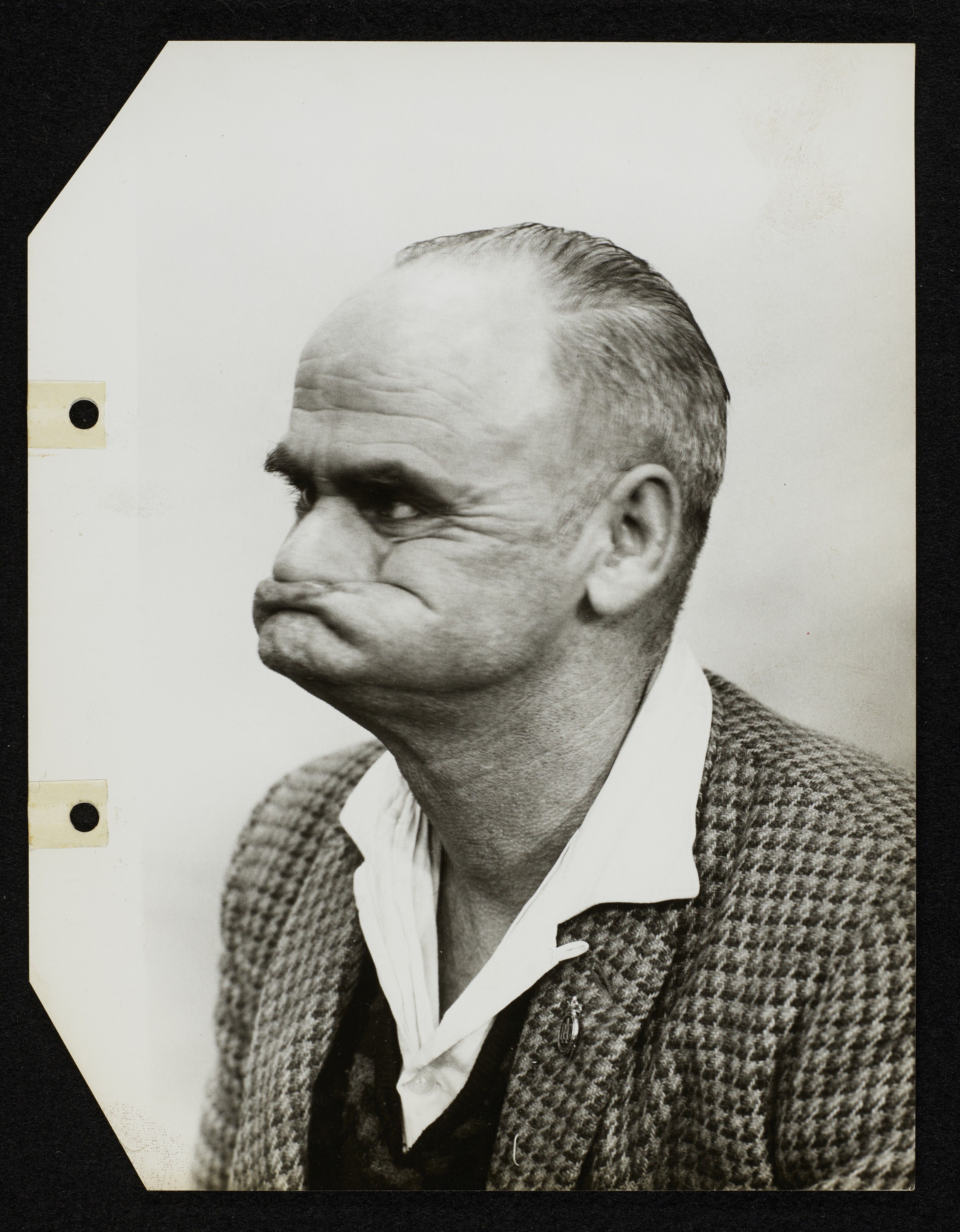
Egremont Crab Fair’s headline event is the World Gurning Championship.
To gurn means to twist your face into grotesque or hilarious shapes. At the Crab Fair, pulling a funny face reaches Olympian levels.
Contestants put their heads through a horse collar, or braffin, and pull their faces for a panel of local dignitaries and guest judges.
The game’s origins are uncertain. Some say it began as a ritual mocking of the so-called village idiot. The earliest written mention comes from local newspaper The Cumberland Paquet in 1852, which called it an “ancient tradition”.
Champions often hold on to their titles for years. Anne Woods dominated the women’s division from 1977 to 2010, winning a record 28 times.
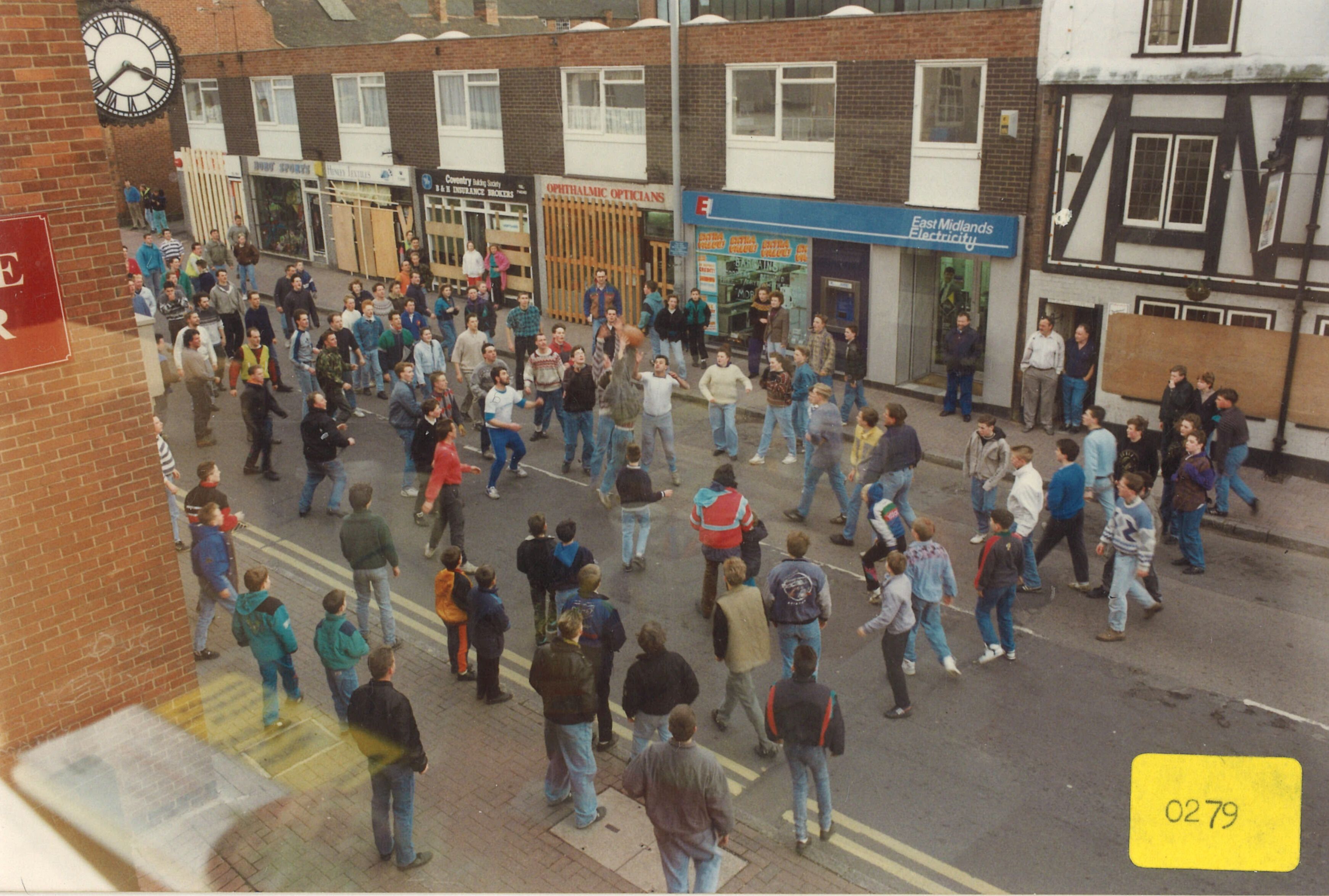
Atherstone Ball Game
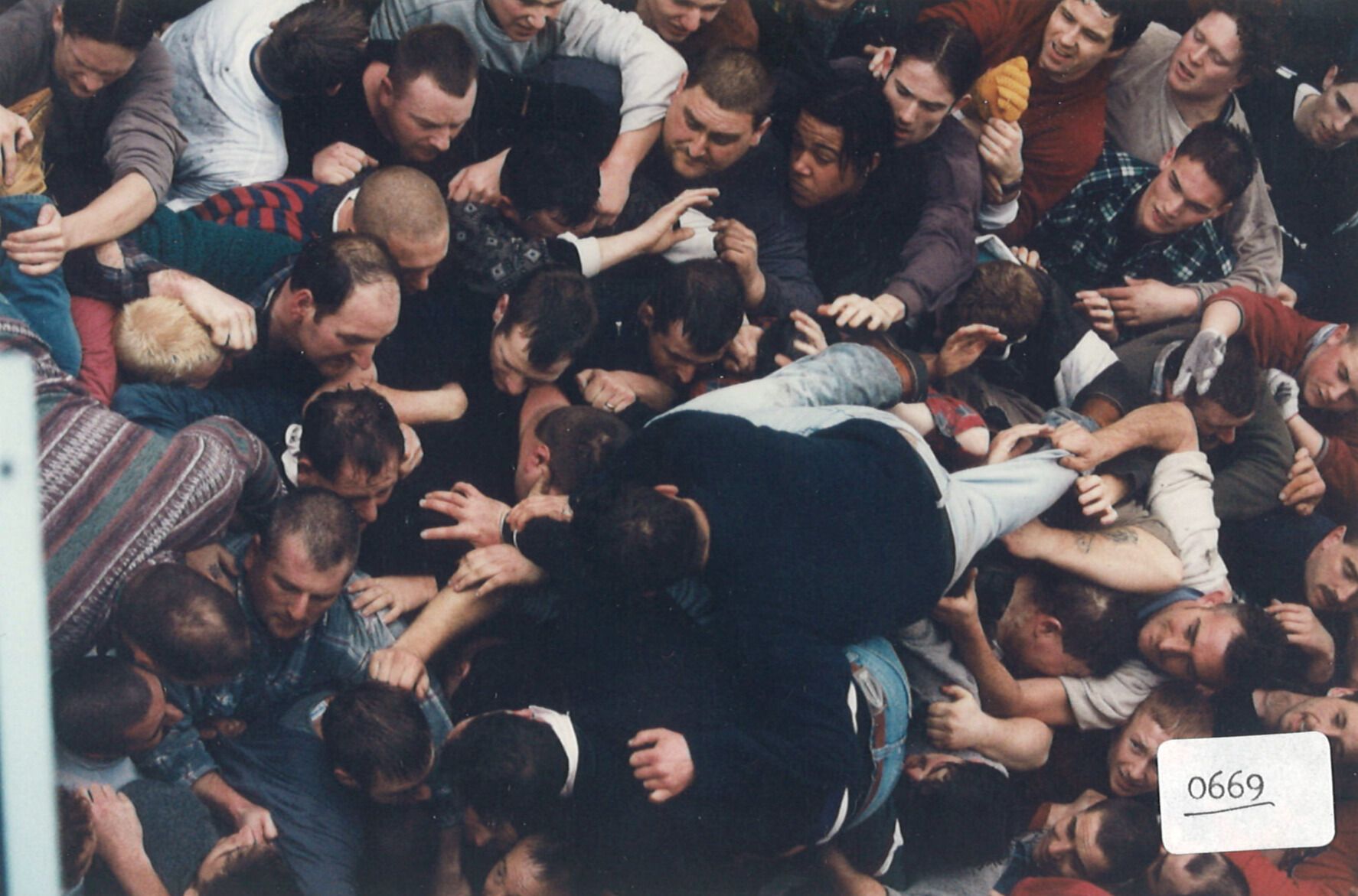
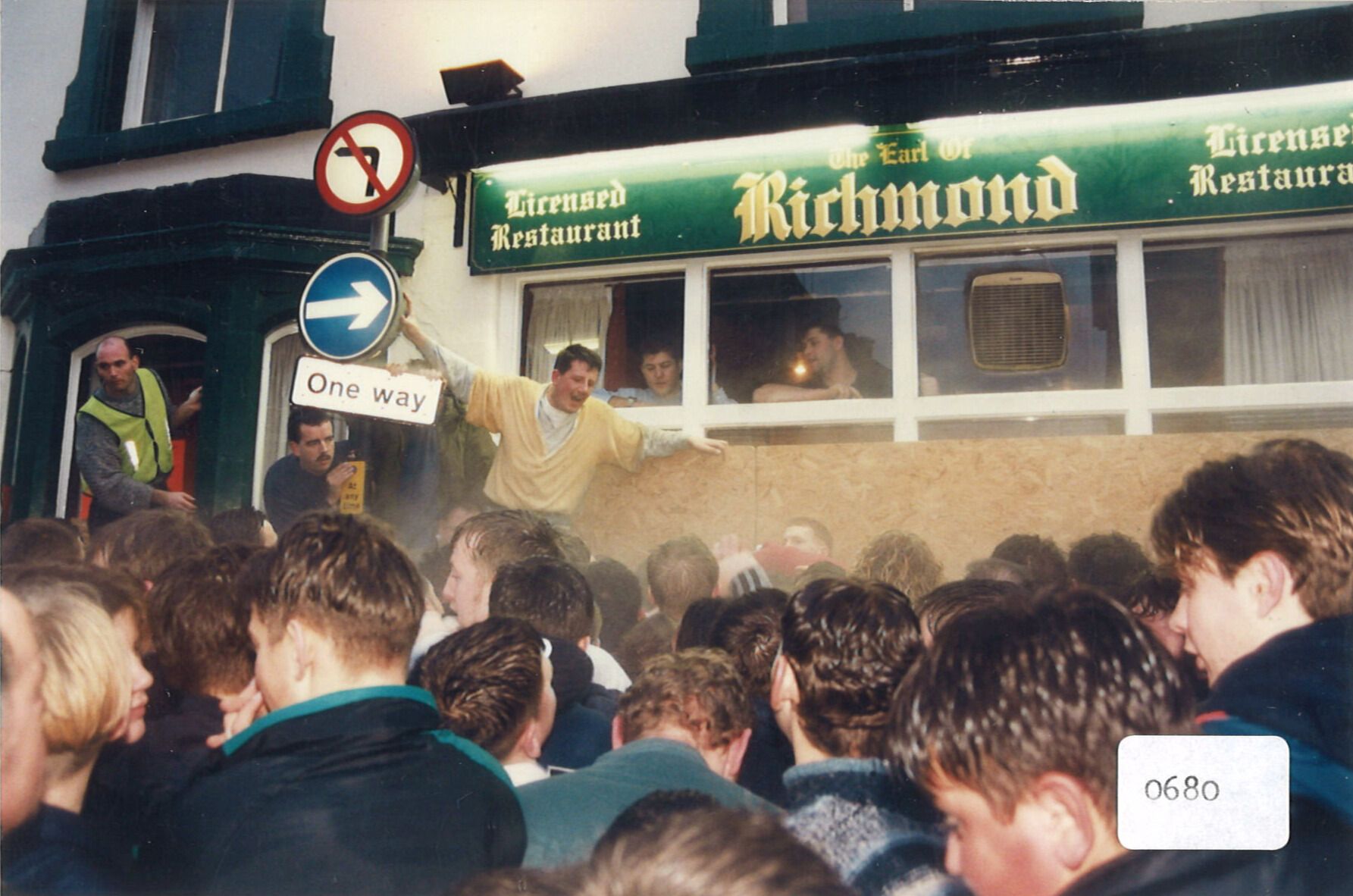
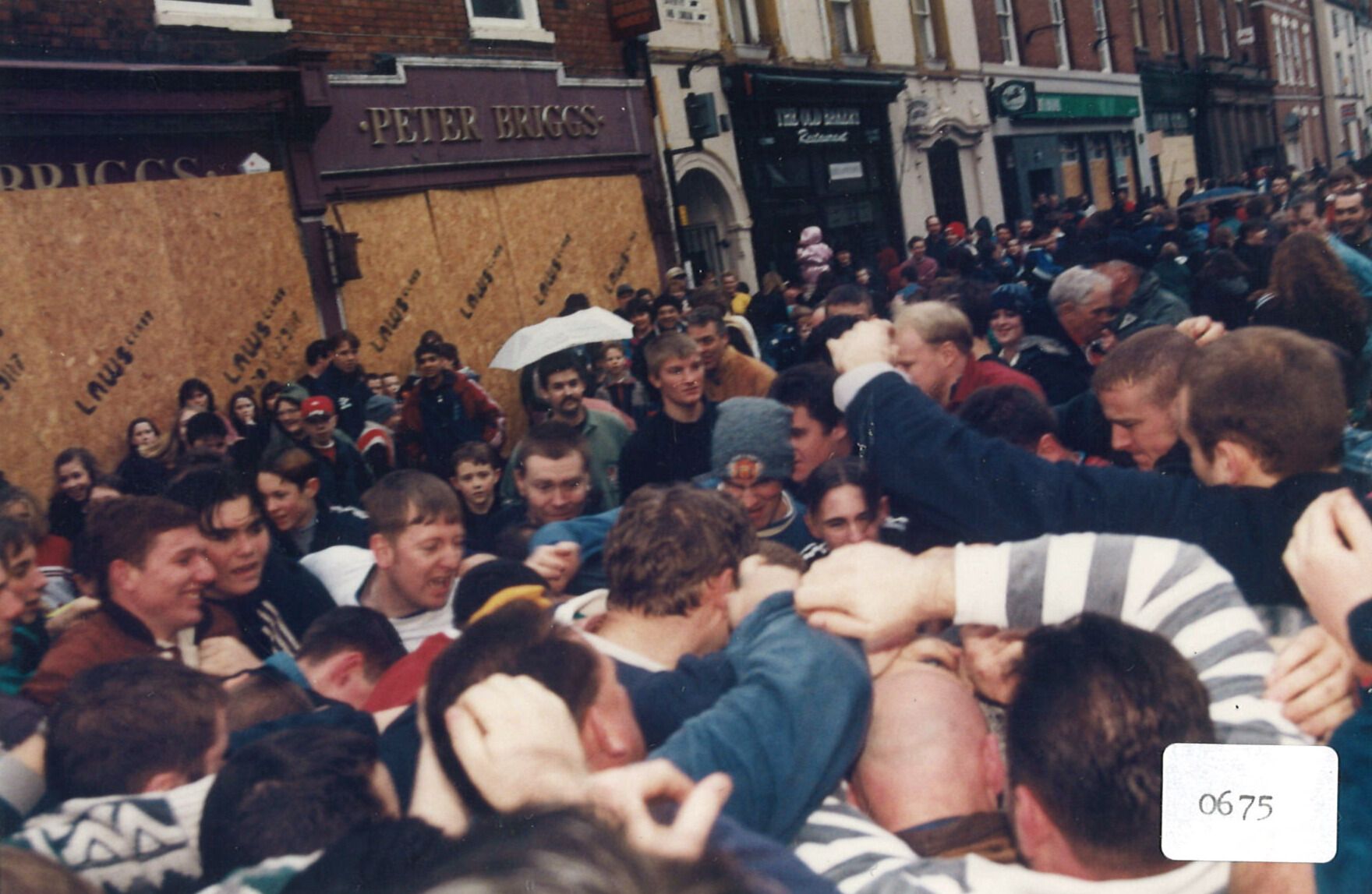
At first glance, photos of the Atherstone Ball Game make it look like a lively, slightly cramped street festival.
But get too close and you’ll get swept up in a centuries-old contest of Warwickshire grit.
Local legend says the game began in 1199, when Warwickshire and Leicestershire played a match of medieval football.
The prize? A bag of gold from King John.
Since then, Atherstone has played their own version of medieval football every Shrove Tuesday.
It starts when a large, heavy ball, filled with water and covered in ribbons, is dropped into the crowd.
Apart from keeping play to Atherstone’s Long Street and asking players not to hurt each other too badly, there are almost no rules.
It’s a free-for-all. Whoever is holding the ball when the church bell strikes 5pm wins.
On the ball
Events like the Atherstone Ball Game evolve over time, with each new generation putting their own stamp on the occasion.
Sometimes they inspire entirely new sports.
According to local historians, Warwickshire schoolboy William Webb Ellis (1806-1872) was so excited by an Easter trip to Atherstone that he brought a version of the game back to his school’s playing fields.
With that, the game of rugby was born, named after Webb Ellis’ school.
Whilst there’s not much proof for this story, it invites us to look at the sports played, watched, and enjoyed around the world today and consider the weird and wonderful historical games from which they originate.
💡 Historically, the game was always started by a footballer or rugby player.
The most famous example was legendary England goalkeeper Gordon Banks, who kicked off proceedings in 1995.
In recent years this honour has been widened to celebrities from other fields, with famous faces including Sid James and Ken Dodd.
In 2024, the game was started by locally-born comedian Josh Pugh.
“No referee could declare the pitch unfit—for this game knows no referee. It’s an all-in scramble.”
Read all about it!
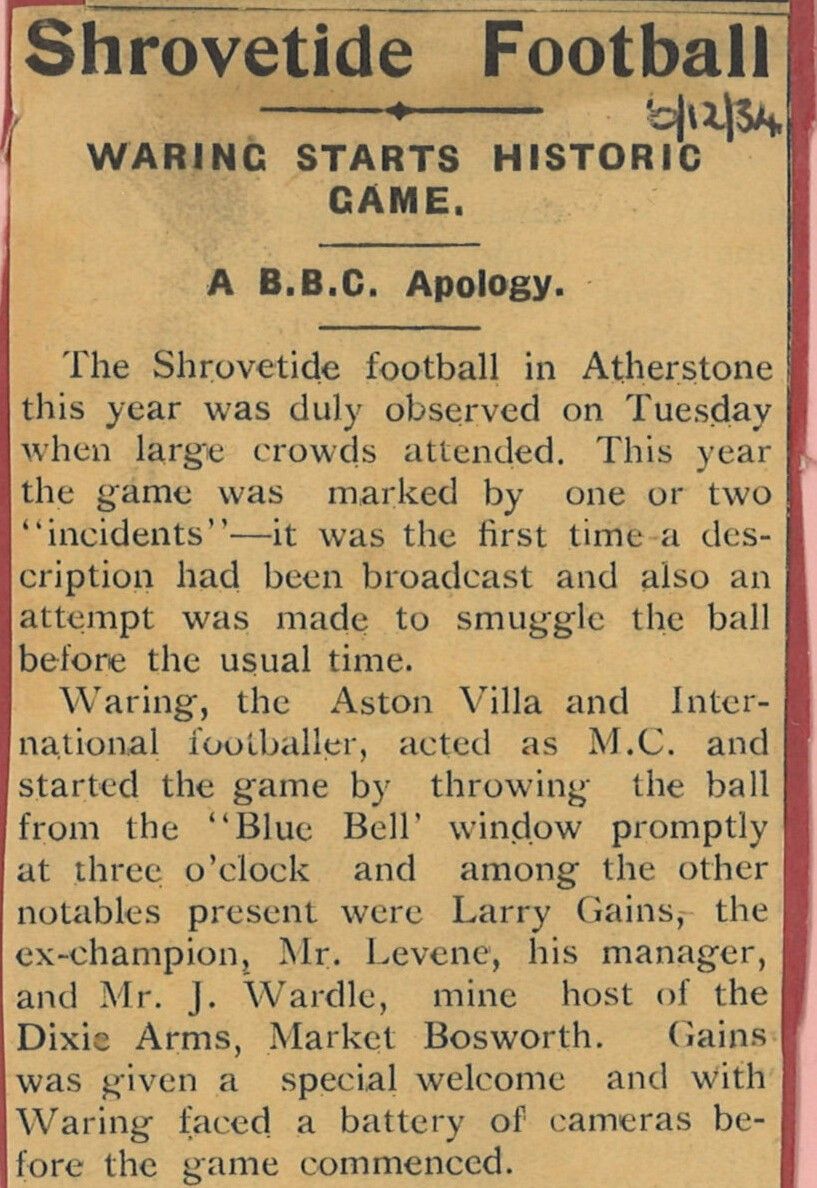
The Atherstone Ball Game has had plenty of controversy over the years.
Incidents such as property damage, injuries and even the use of fish as missiles have fuelled debates about whether the game should continue.
Local newspapers are the best place to find these debates — and plenty of comic stories too.
Warwickshire Libraries has gathered a collection of clippings from across the decades, available to view on request. Here are some highlights.
Discover more
- Lincolnshire Folklore (1936) — Ethel R. Rudkin’s seminal history of Lincolnshire folk traditions
- A Topographical Account of the Isle of Axholme (1815) — William Peck’s local history book, held in North Lincolnshire Libraries’ reference section
- North Lincolnshire family and local history research — Tim Davies’ bespoke service for researching the library’s archives
- Haxey Hood website — Semi-official web page of the Hood, featuring archival images going back to 1905
- Cumbria Archives — Searchable digital database of Whitehaven and other Cumbrian archives
- Egremont Crab Fair website — Official site of Egremont Crab Fair
- Archival Crab Fair footage — British Pathé newsreel footage from the 1969 fair
- World Gurning Championship Hall of Fame — List of all winners and runners up since 1945
- Warwickshire County Record Office — Searchable database of Warwickshire local studies artefacts
- Uppies and Downies: The Extraordinary Football Games of Britain (2008) — Hugh Hornby’s overview of Britain’s folk football games, including the Atherstone Ball Game
- British Newspaper Archive — Millions of digitised newspapers, accessible in the library
- Local Studies at Warwickshire Libraries — Catalogue of Warwickshire Libraries’ local studies collections
- Community sports in Workington, Cumbria (1913) — Archival footage of Uppies and Downies, a medieval football match held in Workington, Cumbria
- The History of Egremont Crab Fair, narrated by Steve Foster — Recording of the Crab Fair Committee President narrating the event’s history
Partners
Thank you to North Lincolnshire Libraries, Whitehaven Archive and Local Studies Centre, Cumberland Libraries and Warwickshire Libraries for sharing their special collections with us.